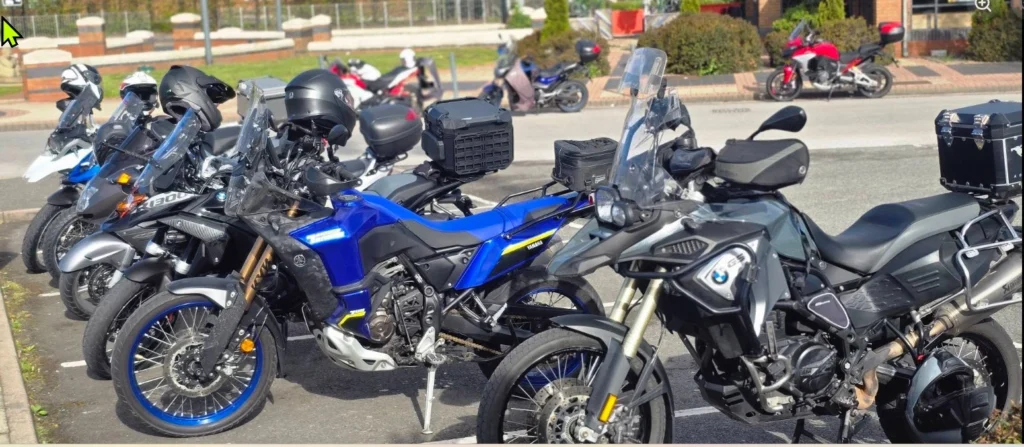
Riding a motorcycle riding isn’t a learn and forget experience. It is constantly changing to meet new laws, government policy, different riding environments and most important, motorcyclist’s training needs. This is why, this week, Chris Lund (Chief Observer) held a meeting, with the help of Associates in training and riders who have recently passed their advanced riding test, to review our training provision. It is vital that any rider training captures the experience of those in training and those who have recently pass the IAM test. Training has to be fit for purpose and those who undertake it should have confidence that we can meet their we are here to meet their personal training needs. A full report will follow later.
if you’ve been on the fence about getting on two wheels, the stars are finally aligning. This isn’t just about getting from A to B; it’s about claiming a level of freedom that a packed bus or a parent’s hatchback simply can’t touch.
The latest news is a massive win for us. With **Hackney Council** scrapping those steep parking charges, the momentum is shifting back to the rider. We’re seeing a world where motorcycles are recognised as the ultimate urban “cheat code.” Plus, the tech dropping right now is insane. Whether it’s the punchy **Bajaj Pulsar NS400** making A2 performance actually affordable, or **KTM’s** electric dirt bikes proving that “green” can still mean “beast mode,” there has never been a better time to be a young rider in the UK.
The community is winning, the gear is looking sharper than ever, and those proposed “Progressive Access” rules mean your journey from a CBT to a full-fat licence is about to get a whole lot smoother. Don’t just watch the **WSBK** pros from your sofa—get out there, grab some L-plates, and start your own story. The road is calling, and honestly? It’s never sounded better.
Whatever you ride and wherever your journey takes you, ride safe and happy reading.
The past seven days have delivered a revealing snapshot of a global motorcycle industry balancing innovation, accessibility and competition, while quietly reshaping the future of both road and racing.
The most immediate story is the continued surge in mid-capacity and accessible motorcycles. Triumph’s expanding 400cc family has now grown again, with a café racer-styled Thruxton 400 entering the frame—an A2-friendly machine aimed squarely at younger riders seeking premium styling without intimidating performance. This reflects a wider industry shift: manufacturers are chasing volume through approachable bikes rather than litre-class flagships.
That strategy is echoed globally. BMW’s upcoming F 450 GS—set for imminent launch—signals how major brands are targeting the lucrative entry-level adventure segment, combining premium branding with smaller-capacity practicality. At the same time, Suzuki UK has publicly committed to doubling its sales, backed by aggressive pricing cuts across much of its range and the offer of up to a 10-year warranty—one of the most ambitious value-led pushes in the British market today.
Taken together, these moves underline a clear reality: affordability, finance and ownership value are now as critical as outright performance.
While petrol bikes still dominate sales, the technological conversation is increasingly electric—and this week’s developments reinforce that trajectory. New machines highlighted across the industry include advanced electric models featuring AI-assisted safety systems such as adaptive cruise control and collision warning, alongside experimental self-balancing capabilities.
More significantly, the push toward next-generation batteries continues. Solid-state technology—promising dramatically improved range and rapid charging—has edged closer to production viability, with claims of up to 370 miles per charge and ultra-fast top-ups. If realised at scale, that would address two of the biggest barriers to electric motorcycle adoption: range anxiety and charging time.
For riders, this is no longer theoretical. The pace of development suggests meaningful real-world impact within the next few product cycles.
On track, the 2026 season is gathering momentum across multiple disciplines. MotoAmerica’s Superbike championship has just begun its 50th season, signalling both continuity and renewed manufacturer investment in domestic racing. Meanwhile, grassroots development remains strong: the Moto4 British Cup continues to provide a structured pathway for young riders, reinforcing the sport’s long-term talent pipeline.
At the elite level, MotoGP itself is in a transitional phase. This is the final season for the current 1000cc formula before sweeping regulation changes in 2027, including a move to 850cc engines and a new tyre supplier. The introduction of the Harley-Davidson-backed “Bagger World Cup” series also highlights efforts to broaden the sport’s appeal and attract new audiences.
Beyond hard news, the industry continues to lean heavily on heritage and identity. Concepts like Harley-Davidson’s Revolution Max café racer blend nostalgia with modern engineering, showing how brands are targeting younger riders without abandoning legacy cues. Simultaneously, retro-inspired production bikes—from Triumph to smaller emerging brands—remain central to showroom appeal.
What emerges this week is a coherent narrative: motorcycling is becoming more inclusive, more technologically ambitious and more strategically competitive. Entry-level machines are improving, electric innovation is accelerating, and racing continues to evolve as both a proving ground and a marketing tool.
For riders—especially younger ones—the result is a market offering more choice than ever, but also one increasingly shaped by value, usability and relevance to everyday life.
7.30pm 11th May 2026
IT’S THE ANNUAL GENERAL MEETING (there’s FOOD!!)
Treeton Miners Welfare
Arundel Road
Treeton
Rotherham S60 5PW
7pm 30th April 2026 (via Google Meet)
see website calendar for details
Advanced riders are safer, have fewer and less serious accidents. Our Associates, Observers and Advanced Rider members are out success.
The “Fresh Start” series emphasizes that “Core Skills” are the essential foundations for all advanced riding. This braking review uses a six-part structure—Myth, Mechanism, Mistake, Method, Mindset, and Margin—to rebuild these fundamentals.
The central Mechanism is that “grip grows with load”; progressive braking transfers weight forward, expanding the front tyre’s contact patch for maximum stopping power. Riders must overcome the Myth that front brakes are dangerous, a belief rooted in older technology. The most common Mistake is “grabbing” the lever due to surprise, which overwhelms tyre grip before the suspension settles.
The Method prioritizes a “Settle – Squeeze – Ease” approach. Riders should support their body weight with their core and legs to maintain control “feel” at the bars. Williams recommends a “front first” sequence for emergency stops to simplify coordination under stress. However, the rear brake is preferred for low-speed maneuvers.
The Mindset goal is developing a “rehearsed response” through regular drills so techniques become automatic. Ultimately, effective braking provides a Margin of safety by “buying time” and creating options to manage hazards. This structured reset ensures riding becomes safer, smoother, and more predictable.
The sources examine the **SMIDSY** (“Sorry Mate I Didn’t See You”) accident, highlighting a new course by Phoenix Training and Professor David Crundall. Research indicates that biological and cognitive limitations, rather than simple negligence, often cause these collisions. Drivers rely on **”schemata”** built from car-dominated traffic, making it harder to perceive motorcycles. Furthermore, **”Global Precedence Theory”** explains how the brain prioritizes overall scenes over small objects, while the **”looming effect”** causes drivers to misjudge a motorcycle’s approach speed.
Kevin Williams argues that these findings align with his own **”Science Of Being Seen” (SOBS)** project, which has synthesised this science since 2012. He suggests proactive driver scanning techniques, such as **”head bobbing”** to see around vehicle pillars and the **”double-check pause”**. Williams contends that characterising this research as “groundbreaking” fails to acknowledge existing efforts like SOBS and the **”Biker Down”** course. Ultimately, the sources warn riders that even if a driver looks in their direction, they may not have actually perceived the motorcycle, necessitating defensive riding to reduce risk.
The source disputes the claim that new research into **SMIDSY** (“Sorry Mate I Didn’t See You”) collisions is “groundbreaking,” noting that these accidents have been rigorously studied since the 1960s. Instead of a lack of evidence, the author argues the primary problem has been **accessibility**; vital research remained “buried” in technical academic journals, institutional archives, or behind paywalls. Consequently, the motorcycling community often relied on **“folklore”** and oversimplified myths rather than scientific facts.
To address this gap, Kevin Williams developed **“The Science of Being Seen” (SOBS)** project starting in 2011. SOBS is categorized as **secondary research**, functioning as a “narrative synthesis” that gathers, evaluates, and simplifies decades of existing primary data. Unlike a formal statistical metastudy, SOBS focuses on pulling scattered academic threads together to explain the mechanisms of driver perception in a way that riders can actually understand. The project’s unique value lies not in new discoveries, but in stripping away “referred knowledge” and replacing it with a **coherent, evidence-based overview**. By making this “buried” science accessible, SOBS provides practical, useful insights for ordinary riders to manage junction risks.
The source identifies **“runaway emotions”**—such as rage, bravado, and peer pressure—as a significant **“boobytrap”** for motorcyclists. These emotions degrade decision-making by narrowing attention and suppressing risk assessment.
Williams uses the metaphor of **“Mr. Toad”** to illustrate how ego hijacks a rider through **“identification inflation”** (acting like a hero), **“emotional hijack”** (feelings overriding thought), **“competence illusion”** (unearned overconfidence), and **“narrative blindness”** (ignoring road realities).
A particularly insidious trap is the **“noble cause,”** often felt by emergency or delivery riders. This is the belief that a vital task justifies higher risk-taking, leading to dangerous **tunnel vision** and over-commitment. Williams shares his experience as a courier and blood biker, noting the psychological pull to “make progress” despite the risks.
The essential **“Survival Skill”** is not suppressing emotion entirely, but recognizing the surge and refusing to let it take control. Riders should **“recognize, then reset”** by pausing, breathing, and refocusing. Ultimately, restraint is framed as a necessity for survival, ensuring the rider—not their emotion—remains the **“pilot-in-charge”**.
We started as the Institute of Advanced Motorists in 1956. Founded by a group of motoring enthusiasts who wanted to promote a better standard of driving. Seven decades on, we’ve evolved our offer. We’ve taken UK licence holders – car and bike, through additional coaching and learning, improving their skills – making the roads safer for all.
© 2026 Sheffield Advanced Motorcyclists. All rights reserved. All content in this newsletter, including text, graphics, and images, is protected by UK copyright law. We gratefully acknowledge the copyright of original publishers and creators for any third-party materials featured. All such materials are used with implied permission, from online publicly shareable URLs, or under fair dealing rules on information, education and public interest. Any such content is used solely for our purposes to educate and inform our readers. Material from other providers is not not used for any commercial purpose. All URLs link directly to copyright holders. The correctness and truthfulness of all such content is the sole responsibility of those providers No part of this publication may be reproduced or shared without prior written consent from the respective copyright holders.
Sheffield Advanced Motorcyclists is a registered charity in England and Wales (No. 1089671).
Riding a motorcycle comes with risks. In an accident, motorcyclists’ injuries are likely to be more serious than those of other road users. To reduce these risks, the Biker I.C.E. (In Case of Emergency) Card is a simple but essential tool for riders. It’s easy to use and convenient to carry. It can be folded to fit in your wallet and handed to anyone who needs it, not just accident responders.
The Biker I.C.E. Card contains all necessary information. It has contact information, important health, medical and doctor’s details, a list of medications and your doctor’s contact. If you’re in an accident, emergency services can use the card to quickly understand your health and medical needs t0 provide you with the best care possible.
Just fill in your email address below. We will keep you updated of any design changes. The card is given as FREE public service that you can use and share as many times as you like. You simply add details like your NHS or travel insurance numbers, as these can help emergency responders access your healthcare records or handle costs when travelling abroad.
Sheffield Advanced Motorcyclists, well known for our quality assured advanced rider training, support the use of this card. It can be a critical safety tool. While training improves road safety, the card ensures you get the right help should things go wrong.
Download your Biker I.C.E. Card NOW, for safer rides and peace of mind!